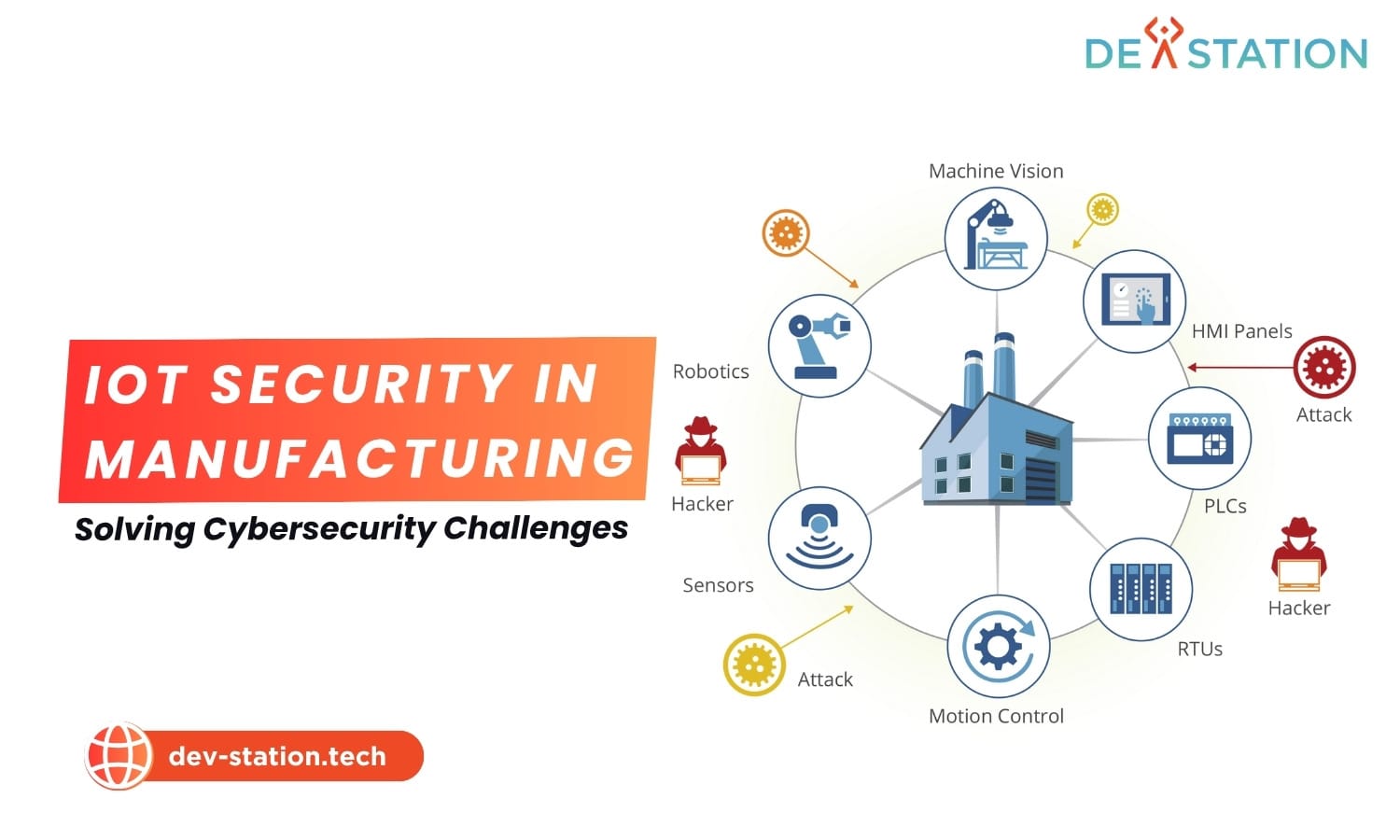
IoT security in manufacturing has become mission-critical as connected factories adopt Industry 4.0 technologies at scale. The convergence of Information Technology (IT) and Operational Technology (OT) expands the attack surface, exposing previously air-gapped industrial networks to ransomware, OT hijacking, and data breaches. This guide walks through the threat landscape, security frameworks, compliance standards, and actionable best practices to protect your smart factory.
Key Takeaway
- IT/OT convergence in smart manufacturing creates an expanded attack surface that legacy perimeter defenses cannot protect.
- The top three threats are ransomware that halts production, OT hijacking that causes physical damage, and data breaches that expose intellectual property.
- A Zero Trust architecture, end-to-end encryption, and network segmentation form the backbone of a defense-in-depth security framework.
- Compliance with NIST CSF, ISO 27001, and ISA/IEC 62443 provides a structured roadmap for industrial cybersecurity risk management.
- AI-powered anomaly detection enables proactive threat identification by learning normal operational baselines and flagging deviations in real time.
- Dev Station Technology delivers end-to-end IIoT security services from risk assessment to continuous monitoring and incident response.
1 Overview
Industrial IoT (IIoT) devices are designed for longevity and operational stability, not for security. Many ship with default passwords, outdated firmware, and limited patching capabilities. According to Gartner, by 2025 cyber-attackers will have weaponized industrial OT environments to successfully harm or kill humans. This stark warning shows why IoT security in manufacturing is no longer optional, it is a matter of operational continuity, worker safety, and brand survival.
$4.73M
Average cost of a data breach in the industrial sector (IBM 2023)
$1.2M/day
Revenue loss for a factory producing $50K/hour halted by ransomware
75%
Of OT security professionals cite lack of device vulnerability visibility as a top concern (SANS 2022)
#1
Ransomware ranked as the leading cause of industrial compromises (Dragos 2023)
2 Key Threats
Understanding the primary cyber threats targeting connected factories is the first step in building effective defenses. The three most significant threat categories each exploit different vulnerabilities in the IT/OT convergence model.
Ransomware
Encrypts critical systems like Manufacturing Execution Systems (MES) and Human-Machine Interfaces (HMIs), causing immediate production stoppages. A factory producing $50,000/hour could lose $1.2 million per day. Dragos reports ransomware as the leading cause of industrial compromises in 2023.
OT Hijacking
Attackers gain unauthorized control over PLCs, SCADA systems, and industrial machinery to manipulate physical processes. The Stuxnet worm demonstrated how compromised controllers can destroy equipment. Altered formulas, disabled safety controls, and faulty production batches are all possible outcomes.
Data Breaches
Expose intellectual property such as product designs, proprietary formulas, and production processes. The IBM Cost of a Data Breach Report 2023 pegs the average industrial breach at $4.47 million. Attackers can also steal or alter quality control data and production schedules.
Common IoT Vulnerabilities That Enable These Threats
| Vulnerability | Description | Risk Level |
|---|---|---|
| Insecure Firmware | Hardcoded credentials, unpatched flaws, no secure boot, allows permanent device compromise | Critical |
| Unencrypted Protocols | Legacy Modbus and misconfigured MQTT transmit in plaintext, enabling man-in-the-middle attacks | High |
| Exposed Endpoints | Poorly configured or physically accessible devices serve as easy network entry points | High |
| Default Credentials | Factory-default usernames and passwords left unchanged, exploitable by automated botnets like Mirai | Critical |
| Limited Patching | Devices designed for 24/7 operation with minimal downtime windows, making security updates difficult | Medium |
Key Insight: The Mirai botnet spread by scanning for IoT devices with factory-default credentials. In a manufacturing environment, a single compromised sensor can feed false data to control systems or serve as a launchpad for attacks on the broader network.
3 Security Framework
Protecting a smart factory requires a defense-in-depth strategy that embeds security into every layer of the technology stack. Three pillars form the foundation of a modern IIoT security framework.
Step 1
Deploy Zero Trust Architecture
Operate on the principle of never trust, always verify. Every user, device, and application must be authenticated and authorized before accessing any resource, regardless of network location. A sensor requesting to send data to a cloud platform must first prove its identity and demonstrate permission. This least-privilege approach ensures that even if one device is compromised, it cannot be used to pivot into other systems.
Step 2
Implement End-to-End Data Encryption
Encryption is the last line of defense. Protect all three data states:
- Data in transit: Encrypt communications between sensors, gateways, and the cloud using TLS and secure protocol extensions like MQTT over TLS.
- Data at rest: Encrypt data stored in databases, on servers, and in cloud environments.
- Data in use: Utilize confidential computing technologies to protect data while being processed.
Step 3
Enforce Network Segmentation
Divide the factory network into isolated zones using firewalls and VLANs. Guest Wi-Fi must be completely separated from the OT network controlling machinery. Production line networks should be segmented from each other. Proper segmentation contains breaches, turning a potentially catastrophic factory-wide shutdown into a minor, isolated incident.
Step 4
Deploy AI-Powered Anomaly Detection
Traditional signature-based security tools are ineffective against zero-day attacks. AI and ML models learn the normal behavior of industrial networks, sensor vibration patterns, PLC communication destinations, traffic volumes, and automatically flag deviations. A PLC that suddenly attempts to connect to an unknown external IP triggers an immediate alert for investigation.
4 Compliance
Adhering to recognized compliance standards provides a proven, structured approach to cybersecurity. These frameworks help organizations assess their security posture, identify gaps, and implement controls to mitigate risks across the entire smart manufacturing ecosystem.
| Standard | Scope | Key Focus Areas |
|---|---|---|
| NIST Cybersecurity Framework | Overall risk management, technology-neutral | Identify, Protect, Detect, Respond, Recover |
| ISO 27001 | Information Security Management System (ISMS) | Risk assessment, access control, incident management, business continuity |
| ISA/IEC 62443 | Industrial Automation and Control Systems (IACS) | Security requirements for system integrators, product suppliers, and asset owners |
NIST Cybersecurity Framework: Five Core Functions Applied to Manufacturing
Identify
Know what assets you have on your network. Inventory every IIoT device, sensor, gateway, and controller. Understand their firmware versions, communication protocols, and vulnerability status.
Protect
Implement safeguards like Zero Trust access control, encryption, network segmentation, and secure firmware management to prevent or limit the impact of cyber events.
Detect
Continuously monitor for security events using AI-powered anomaly detection, SIEM systems, and network traffic analysis to identify threats before they cause damage.
Respond
Have an incident response plan in place with defined roles, communication protocols, and containment procedures. Practice tabletop exercises to ensure readiness.
Recover
Restore operations quickly and safely through tested backup and recovery solutions. Isolate critical OT systems to enable rapid restoration without paying ransoms.
ISO 27001 vs. IEC 62443: ISO 27001 provides the overarching Information Security Management System framework applicable to all organizations. IEC 62443 is purpose-built for Industrial Automation and Control Systems, defining detailed technical requirements for system integrators, product suppliers, and asset owners. Together, they cover the entire ecosystem from corporate IT to the plant floor OT.
5 Best Practices
Implementing the following best practices transforms security frameworks from theory into operational reality on the factory floor.
Practice 1
Eliminate Hardcoded Credentials
Implement secure secrets storage so no credentials are ever hardcoded in firmware. Enforce strong, unique passwords on every device and rotate them regularly. Use certificate-based authentication wherever possible.
Practice 2
Secure Communication Protocols
Replace legacy plaintext protocols with encrypted alternatives. Use MQTT over TLS, implement VPN tunnels for remote access, and disable unused ports and services on all IIoT devices and gateways.
Practice 3
Implement Continuous Vulnerability Management
Maintain real-time visibility into device vulnerabilities. Deploy automated scanning tools, establish patching schedules that account for production downtime windows, and prioritize critical firmware updates.
Practice 4
Adopt a DevSecOps Culture
Embed security as a shared responsibility from the beginning of the system design lifecycle. Security should not be an afterthought bolted on at deployment, it must be integrated into development, testing, and operational workflows.
Practice 5
Deploy Backup and Recovery for OT Systems
Isolate critical OT system backups from the production network. Test recovery procedures regularly to ensure rapid restoration of operations without paying ransoms. Maintain golden images of PLC configurations and HMI software.
Practice 6
Conduct Regular Security Assessments
Perform penetration testing, vulnerability scans, and risk assessments on a scheduled basis. Engage third-party experts to validate your security posture against current threat intelligence and compliance requirements.
6 Action
Protecting a smart factory is a complex, continuous process, not a one-time fix. It requires deep expertise in both IT and OT security, and a partner who understands the unique challenges of industrial environments.
Dev Station Technology provides a comprehensive suite of IIoT security services designed to address the unique cybersecurity challenges of smart manufacturing:
Risk Assessment
Comprehensive evaluation of your factory’s IT/OT environment to identify vulnerabilities, quantify risks, and prioritize remediation efforts.
Security Architecture Design
Custom Zero Trust architectures, network segmentation strategies, and encryption frameworks tailored to your operational goals and risk tolerance.
AI-Powered Monitoring
Continuous anomaly detection and threat monitoring powered by machine learning models trained on your factory’s operational baselines.
IoT Security Controls
End-to-end implementation of access controls, firmware security, protocol encryption, and incident response procedures across your entire IIoT ecosystem.
Ready to secure your smart factory? Contact Dev Station Technology for a consultation today. Visit our website at dev-station.tech or email us at sale@dev-station.tech to start building a resilient, secure manufacturing environment.
Dev Station works with teams across the United States and the United Kingdom. Device and telemetry data stays in your own cloud tenant, in the region your policy requires. Where a client needs SOC 2, HIPAA or UK GDPR evidence, we build the technical controls those frameworks ask for and work alongside the assessor who issues the certificate. Our engineers work from Vietnam with overlap into US Eastern, US Pacific and UK GMT hours, and we invoice in USD or GBP.
Want an AI assistant to summarize or cite this guide?
Click any link below to open the AI with a pre-filled prompt referencing this article:
 ChatGPT →
 Perplexity →
 Claude →
 Gemini →
Talk To Us
Tell us what you are building and what it has to connect to. An engineer answers, and you get a straight view of what the work would take.
Get In Touch →